

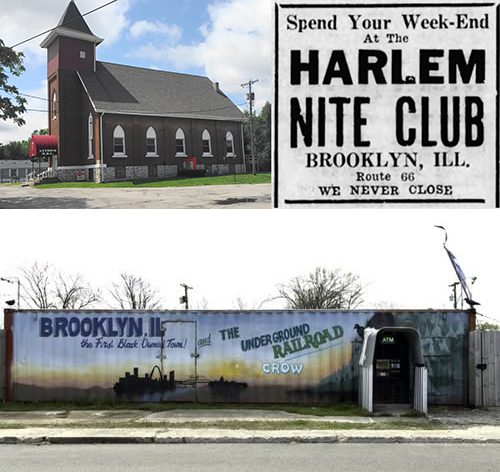
Brooklyn, IL, August 3 & June 26, with text and photo contributions from The Road Ahead & Landmarks Illinois:
The Illinois Route 66 Scenic Byway is excited to share recent updates from America’s oldest African American town, which is located on the original 1926 Route 66 alignment.
From The Road Ahead:
“In recent years, Brooklyn, Illinois, a village in St. Clair County across the river from bustling St. Louis, has been largely overlooked by travelers. The village is not only America’s oldest Black town, but also sits along the original alignment of Route 66.
Settled around 1829, Brooklyn was one of the first places where formerly enslaved people could buy land, and became a pivotal stop on the Underground Railroad. The town was founded by Priscilla Baltimore, an abolitionist born in Kentucky who, after gaining her freedom in the 1820s, helped purchase the freedom of other enslaved people and establish Brooklyn as a place of refuge. She was also entrusted with guiding enslaved people from St. Louis to Brooklyn to hear William Paul Quinn preach. Quinn later helped found the African Methodist Episcopal (AME) Church in Brooklyn.
Brooklyn reached its population peak around 1940 with roughly 2,000 residents. Its rise coincided with the Harlem Renaissance, and the town became a thriving center for jazz and blues, anchored by the iconic Harlem Club. In 1959, both the Harlem Club and New Champion’s Supermarket were listed in The Negro Motorist Green Book, declaring their status as safe spaces for Black travelers along Route 66. The Harlem Club also earned Brooklyn the nickname “the all-night town,” hosting legendary performers including Tina Turner, B.B. King, and Dinah Washington.
The post-World War II industrial decline hit Brooklyn hard. Over the years, railroad companies purchased vacant lots in an effort to expand rail lines through the town. Today, strip clubs make up much of the town’s commercial corridor, while many former residential lots remain empty. With a population of around 620—less than one-third of its peak—much of the town is now bleak.
The Illinois State Archaeological Survey (ISAS) has had a presence in Brooklyn since 2008. Archaeologist Miranda Yancey and architectural historian Casey L. Weeks are among those working to create a stronger sense of place by educating both residents and visitors about the town’s history. Archaeologists have uncovered artifacts including glassware and ceramics dating back to the 19th century. These excavations help preserve Brooklyn’s history and strengthen efforts to secure its place on the National Register of Historic Places.
Further government investment could help revitalize the community and support its current residents. Federal funding has recently been allocated for a new community center, but additional investment in infrastructure and road improvements is still needed. These projects would not only improve quality of life, but also create jobs. As Brooklyn approaches its bicentennial, ensuring its continued survival is not only about preserving artifacts, but also about investing in the community.”
From Landmarks Illinois:
“On June 26, Landmarks Illinois and the Village of Brooklyn hosted a Route 66 Centennial event to dedicate and install Route 66 signage in Brooklyn, Illinois. After decades of exclusion from route maps and of being overlooked as an integral part of the highway’s history, it is now recognized as part of the Mother Road’s legacy.
Landmarks Illinois President and CEO Bonnie McDonald shared, “We are here to celebrate righting a longtime wrong because Brooklyn has been on Route 66 since its founding and has not been recognized. Today is about celebrating the community and making sure the community is recognized.”

Left to Right: Leslie Hardin, director of community relations for the Village of Brooklyn; Trenton “TC” Atkins, mayor of Brooklyn; Bill Thomas, chair of the Route 66 Road Ahead Partnership and member of the U.S. Route 66 Centennial Commission; Quinn Adamowski, Landmarks Illinois regional advocacy manager; Rhys Martin, Preserve Route 66 manager for the National Trust for Historic Preservation and president of the Oklahoma Route 66 Association; and Casey Claypool, executive director of the Illinois Route 66 Scenic Byway and member of the Illinois Route 66 Centennial Commission.
